Chronicle
Key steps in the Schubertiade's history
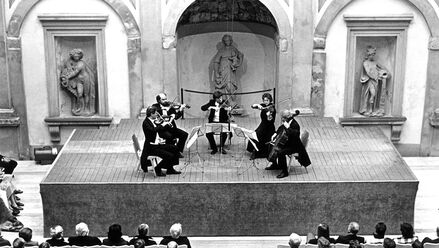
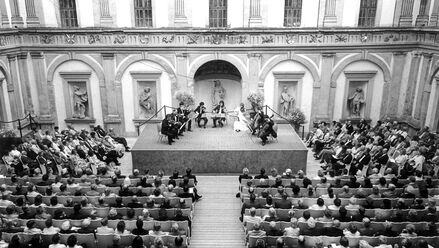
Im Juni wird die »Mozartgemeinde Vorarlberg« durch Gerd Nachbauer mit der Absicht gegründet, in Hohenems einen jährlichen Konzertzyklus mit Werken von Mozart im Mittelpunkt durchzuführen. Als Schauplätze sind der noch nicht beheizbare Rittersaal und der in Renovierung befindliche Hof des Palastes Hohenems, sowie die Pfarrkirche St. Karl vorgesehen Der Beginn der ersten Konzertreihe muß aus finanziellen Erwägungen auf den Herbst 1973 verschoben werden Neben anderen Künstlern wird auch Hermann Prey zur Mitwirkung in den kommenden Jahren eingeladen.
Am 19. September findet im Rittersaal das erste Konzert der Mozartgemeinde als Festkonzert zum 400. Geburtstag von Graf Kaspar von Hohenems mit Vokalensembles von Mozart statt.
In der Planungsphase eines für den Juni 1975 vorgesehenen Liederabends schreibt Hermann Preys Sekretär Christian Lange im Mai an Gerd Nachbauer, dieses Konzert könne der Test sein für ein größeres, eng mit den Namen Prey und Schubert verbundenes Projekt Lange kommt im Juli nach Hohenems, um die möglichen Schauplätze zu fotografieren und mit Gerd Nachbauer einen Programmvorschlag für eine erste Schubertiade 1976 zu erstellen. Prey akzeptiert den Palast Hohenems als Veranstaltungsort und den Programmvorschlag. Ab 1978 soll dann nach Preys Wunsch innerhalb von 12 Jahren Schuberts Gesamtwerk in chronologischer Reihenfolge aufgeführt werden Von Bund, Land und Gemeinde können Zusagen zur Subventionierung erreicht werden Im November singt Prey in Bregenz Schuberts »Winterreise«. Am Tag zuvor kann er erstmals den Palast in Hohenems besichtigen und bei einer Pressekonferenz wird das Schubertiade-Projekt der Öffentlichkeit vorgestellt.
Im Jänner wird die »Schubertiade Hohenems Ges.m.b.H.« gegründet. (Gesellschafter und Geschäftsführer: Christian Lange und Gerd Nachbauer) Im März erscheint der Prospekt der Schubertiade Hohenems 1976 (8. bis 16. Mai).
Der Rittersaal im Palast Hohenems wird renoviert und erhält eine Bodenheizung Am Vorabend des ersten Schubertiade-Konzerts wird am Geburtshaus von Salomon Sulzer durch Hermann Prey eine Gedenktafel enthüllt Die erste Schubertiade beginnt am 8. Mai mit einem Liederabend von Hermann Prey, am Klavier ist Leonard Hokanson.
Christian Lange scheidet am 1. Jänner als Geschäftsführer der Schubertiade aus Im Laufe des Frühjahrs wird im Palast eine mobile Hofüberdachung errichtet Hermann Prey sagt über mehrere Monate alle Verpflichtungen ab. Auch seine Mitwirkung bei der Schubertiade ist bis zuletzt fraglich Die Wiener Philharmoniker eröffnen unter der Leitung von Karl Böhm am 19. Juni die zweite Schubertiade Gemeinsam mit den Wiener Philharmonikern veranstaltet die Schubertiade eine Ausstellung über Joseph Sulzer, einen Sohn von Salomon Sulzer und langjährigen Cellisten der Philharmoniker Nach Abschluß der Schubertiade 1977 stellt sich heraus, daß an einen Beginn der chronologischen Aufführungsserie im Jahr 1978 aus finanziellen Gründen nicht zu denken ist. Unter anderem sind die in Aussicht gestellten geringfügigen Erhöhungen der Subventionen nicht ausreichend, um die wesentlich teureren gemischten Programme in einem kleinen Saal zu finanzieren.
Der prominente englische Journalist Bernard Levin berichtet für die Londoner Times erstmals über die Schubertiade.
Die Schubertiade veranstaltet im Palast eine Ausstellung zum 450. Geburtstag von Graf Jakob Hannibal I. von Hohenems mit Dokumenten aus dem Palastarchiv Hermann Prey gibt am Ende seines Liederabends zum Abschluß der Schubertiade seinen Rücktritt als Künstlerischer Leiter bekannt, da aus vorwiegend finanziellen Gründen in Hohenems die von ihm angestrebte chronologische Aufführung sämtlicher Werke Schuberts nicht realisiert werden konnte.
Letzter Auftritt von Hermann Prey bei der Schubertiade.
Hans Hotter, der sich bereits vor einigen Jahren von der Bühne verabschiedet hatte, singt statt Peter Schreier die »Winterreise«.
Am 8. Mai erscheint in der New York Times eine große Vorschau auf die weltweit wichtigsten Festivals des Jahres. Bernard Levin wird eingeladen, ein Festival seiner Wahl als Einleitung besonders groß herauszustellen, und entscheidet sich für die Schubertiade Hohenems. Unter dem Titel »Austria’s Serenade to Schubert« ist dort unter anderem zu lesen: »Unter allen musikalischen Festivals der Welt – von denen es nun Tausende gibt – ist das von Hohenems vielleicht das reinste und am ehesten vollkommene« Dietrich Fischer-Dieskau und Nikolaus Harnoncourt wirken zum ersten Mal bei der Schubertiade mit.
Unter dem Motto »Schuberts Vorbilder« werden ab diesem Jahr neben Schubert auch andere Komponisten in das Programm aufgenommen Nikolaus Harnoncourt dirigiert zum ersten Mal ein Werk Beethovens.
Dietrich Fischer-Dieskau singt vier Liederabende im Montforthaus in Feldkirch, welches mangels geeigneter Räumlichkeiten in Hohenems vermehrt in das Schubertiade-Programm eingebunden wird.
Nikolaus Harnoncourt dirigiert zwei konzertante Aufführung von Beethovens Oper »Fidelio«.
Im »Courvoisier’s Book of the Best«, das von Lord Lichfield, einem Verwandten von Queen Elizabeth II., in London herausgegeben wird, erscheint die Schubertiade Hohenems in einer Liste der zehn führenden Festivals der Welt an fünfter Stelle (hinter Bayreuth, Salzburg, Glyndebourne und Spoleto).
Nach einer umfassenden Renovierung steht der Konservatoriumssaal in Feldkirch als weiterer Aufführungsort zur Verfügung Auf dem Programm stehen unter anderem alle Lieder, die Schubert selbst veröffentlicht hat und, gespielt vom Tokyo String Quartet, sämtliche Streichquartette.
Wegen der durch eine Landesausstellung im Palast Hohenems sich abzeichnenden Einschränkungen und Behinderungen findet erstmals die gesamte Schubertiade in Feldkirch statt. An diesem Zustand ändert sich auch in den folgenden Jahren nichts, da von der Stadt keine Zusage für die in Zukunft störungsfreie Durchführung in Hohenems erhalten werden kann.
Nikolaus Harnoncourt führt mit dem Concertgebouw Orchester Amsterdam alle Symphonien Schuberts auf, András Schiff spielt alle Klaviersonaten.
Aufführung sämtlicher Schubert-Kompositionen nach Texten von Goethe.
Erste »Landpartien« zum Schloß Achberg, zur Propstei St. Gerold und nach Schwarzenberg, auf deren Programm jene Werke stehen, die Schubert auf Reisen komponiert oder aufgeführt hat.
Durch verschiedene Verbesserungen wird der Angelika-Kauffmann-Saal in Schwarzenberg zu einem der hervorragendsten Kammermusiksäle.
Bau des Kleinen Dorfsaals in Schwarzenberg.
Anlässlich der Ausstellung »Schubert 200« werden erstmals Schubertiade-Konzerte in Lindau/Deutschland veranstaltet (bis 1999).
Die 25. Schubertiade wird mit einem besonders vielfältigen Programm gefeiert. Erstmals finden auch Konzerte im Hotel Post in Bezau statt.
Das Festival wird auf Schwarzenberg (unter Einbeziehung des Saals im Bezauer Hotel Post) konzentriert. Bis zum Juni 2001 wird der Angelika-Kauffmann-Saal erweitert und umgebaut. Nach dessen Fertigstellung steht der Schubertiade erstmals ein auf ihre Bedürfnisse zugeschnittener, optimaler Veranstaltungsraum zur Verfügung.
Mit 50.400 Besuchern und 99 Veranstaltungen findet in Schwarzenberg die umfangreichste Schubertiade seit Festivalgründung statt Im Oktober informiert Gerd Nachbauer den Turnverein 1885 Hohenems über seine Idee zur Adaptierung der Turnhalle als Konzertsaal – nach der bevorstehenden Übersiedlung des Turnbetriebes in die neue Turnhalle bei der Hauptschule Markt – und findet große Zustimmung. Die Schubertiade GmbH pachtet das Gebäude langfristig und im Dezember wird die Öffentlichkeit über das Vorhaben informiert.
Kurz vor Beginn der 30. Schubertiade beginnen Anfang Mai die Bauarbeiten an der nun Markus-Sittikus-Saal genannten Turnhalle. Durch das Hochwasser am 22. August werden alle für die Konzerte der Schubertiade erstellten Einrichtungen im Hotel Post in Bezau vernichtet. Am 6. Oktober wird der Markus-Sittikus-Saal eröffnet. Peter Schreier beendet am 8. Dezember im Markus-Sittikus-Saal mit seinem 75. Schubertiade-Auftritt seine jahrzehntelange Laufbahn als einer der bedeutendsten Liedersänger. Am folgenden Tag wird am selben Ort der 90. Geburtstag von Elisabeth Schwarzkopf in Anwesenheit der Sängerin mit einem Liederabend von Matthias Goerne gefeiert.
Die Außenrenovierung des Markus-Sittikus-Saales, die Umgestaltung des Vorplatzes sowie die weitläufige Gartenanlage mit Heckentheater werden fertig gestellt.
Die Schubertiade eröffnet das Franz-Schubert-Museum in Hohenems in den Räumen des restaurierten ehemaligen Pfarrhofs. Im selben Jahr wird Elisabeth Schwarzkopf ein Museum in der Villa Rosenthal gewidmet, in dem zahlreiche Originaldokumente, Bilder und Briefe aus dem Nachlaß der 2006 verstorbenen Sängerin und ihres Mannes Walter Legge zu besichtigen sind.
Paul Lewis spielt im Rahmen von acht Konzerten Schuberts wichtigste Klavierwerke und führt mit Mark Padmore die drei großen Liederzyklen auf.
Die Reihe »Referenzen« ermöglicht jungen Musikern aus der Region und Schülern bekannter Schubertiade-Künstlern ihr Debüt im Markus-Sittikus-Saal Das Cuarteto Casals spielt in Schwarzenberg sämtliche Streichquartette von Schubert.
Im April eröffnet die Schubertiade das Legge-Museum mit der Ausstellung »Callas für die Ewigkeit« zum 90. Geburtstag der legendären Sopranistin. Das neue Dreimäderlhaus-Museum in Hohenems zeigt Legenden, Kunst, Kitsch und Kuriositäten um Franz Schubert in Malerei, Literatur, Operette, Film und Devotionalien. (Diese Ausstellung ist seit 2016 in erweiterter Form in das Schubertiade-Museum integriert.)
Sir András Schiff führt mit seiner Cappella Andrea Barca sämtliche Symphonien von Schubert bei der Schubertiade in Schwarzenberg auf. Im Legge-Museum wird 2015 dem Thema »Stefan Zweig und das Musikleben seiner Zeit« ein eigener Raum gewidmet, da der Großvater mütterlicherseits des weltweit geschätzten Schriftstellers Mitbesitzer und Bewohner dieses Hauses war.
Anlässlich des 40. Festivals (2015) und des 40-Jahr-Jubiläums der Schubertiade (2016) stehen, aufgeteilt auf 39 Liederabend-Programme in den Jahren 2015 und 2016, sämtliche Lieder von Franz Schubert auf dem Programm.
Das neue Schubertiade-Museum im 1659 erbauten Haus Marktstraße 15 zeigt die Bemühungen der Nachwelt um Schuberts Werke und Person. Dabei wird auch an die nun 40jährige Geschichte der Schubertiade erinnert. Mit dem kleinen Nibelungen-Museum wird an die folgenreiche Wiederentdeckung des Nibelungenliedes im Palast Hohenems an jener Stelle erinnert, wo vor 400 Jahren die »Emser Chronik« als erstes in Vorarlberg gedrucktes Buch entstand.
Das L'Orfeo Barockorchester unter Leitung von Michi Gaigg spielt sämtliche Symphonien und symphonische Fragmente von Schubert in Hohenems. Die Konzertmitschnitte dienen als Grundlage einer CD-Aufnahme. Weitere CD-Produktionen im Markus-Sittikus-Saal finden u.a. mit dem Jerusalem Quartet, Pavol Breslik, Amir Katz, Sharon Kam, Ori Kam, Matan Porat, Andrè Schuen, Daniel Heide, Sumi Hwang, Helmut Deutsch und Khatia Buniatishvili statt. Im Rahmen der Schubertiade Hohenems und Schwarzenberg wird die gesamte Kammermusik von Johannes Brahms gespielt.
Aufgrund von Covid-19 und den damit verbundenen Beschränkungen durch die Österreichische Bundesregierung müssen alle Konzerte der Schubertiade Hohenems vom 29. April bis 3. Mai, 4. bis 7. Juni und 1. bis 6. Oktober sowie alle Konzerte der Schubertiade Schwarzenberg vom 20. bis 28. Juni und 22. bis 30. August abgesagt werden. Lediglich im Juli finden im Markus-Sittikus-Saal in Hohenems sieben Konzerte statt: zwei Kammerkonzerte sowie fünf Liederabende der Reihe »Neue Stimmen«.
Die fortbestehenden behördlichen Beschränkungen des Veranstaltungsbetriebes und der Reisefreiheit im Zuge der Corona-Pandemie führen zu einer Absage aller Schubertiade-Konzerte im April und Mai (Hohenems) sowie im Juni (Schwarzenberg). Ab August kann das Programm wie angekündigt und ohne Reduktion der Besucherzahlen, aber unter strengen Auflagen beim Einlass, durchgeführt werden.
Erstmals seit Beginn der Pandemie können alle Konzerte der Saison wie angekündigt und ohne Beschränkungen stattfinden. In Hohenems und Schwarzenberg werden sämtliche von Schubert selbst zusammengestellte Lied-Opusnummern in der originalen Reihenfolge aufgeführt. Das Quatuor Modigliani spielt einen Zyklus sämtlicher Streichquartette Schuberts.
»Ganz aus Holz gefertigt, fügt der Angelika-Kauffmann-Saal sich nicht nur unauffällig in den Wiesenhang, er bietet sechshundert Zuhörern nahezu ideale akustische Bedingungen: Es gibt keine schlechten Plätze.«
Frankfurter Allgemeine Zeitung, Germany